
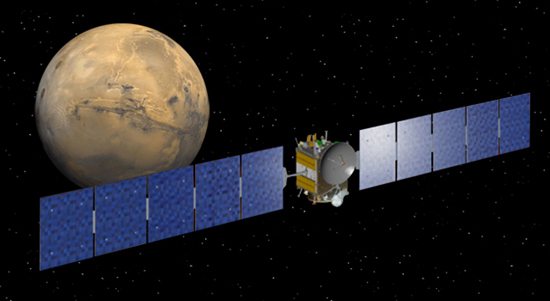
Today, the spacecraft Dawn will get a little help from Mars by using its gravity to alter its course to visit Vesta and Ceres, two of the largest asteroids in the solar system. Dawn, a 2,500-pound satellite launched in September ’07, will come within 341 miles of Mars today at 4:28 PST (7:28 EST) as it swings around the planet and then streaks back out into space at an altered trajectory to ultimately arrive at its first goal in 2011: the asteroid Vesta.
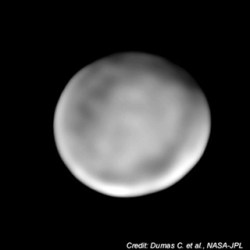
Gravity-assists like these are carefully planned by engineers to aid in navigation, as they require the use of much less energy than altering course with actual fuel consumption. They work in much the same way as a rollerblader could grab onto a lightpole to quickly whip around and change direction.
Vesta and Ceres were some of the first asteroids to be discovered, in 1807 and 1801 respectively, because of their large size. They are important because of what they can tell us about the state of the early solar system, having remained relatively unchanged for billions of years.
Vesta, about the size of Arizona, is a rocky asteroid, while Ceres, as big as Texas, is believed to contain water ice. If it has as much ice as expected, it would actually contain more fresh water than is currently available on Earth. Ceres will be visited by Dawn in 2015.
The Dawn mission will take the craft on an estimated 3 billion mile journey.
Image credits NASA/JPL.
 Lights in the Dark