
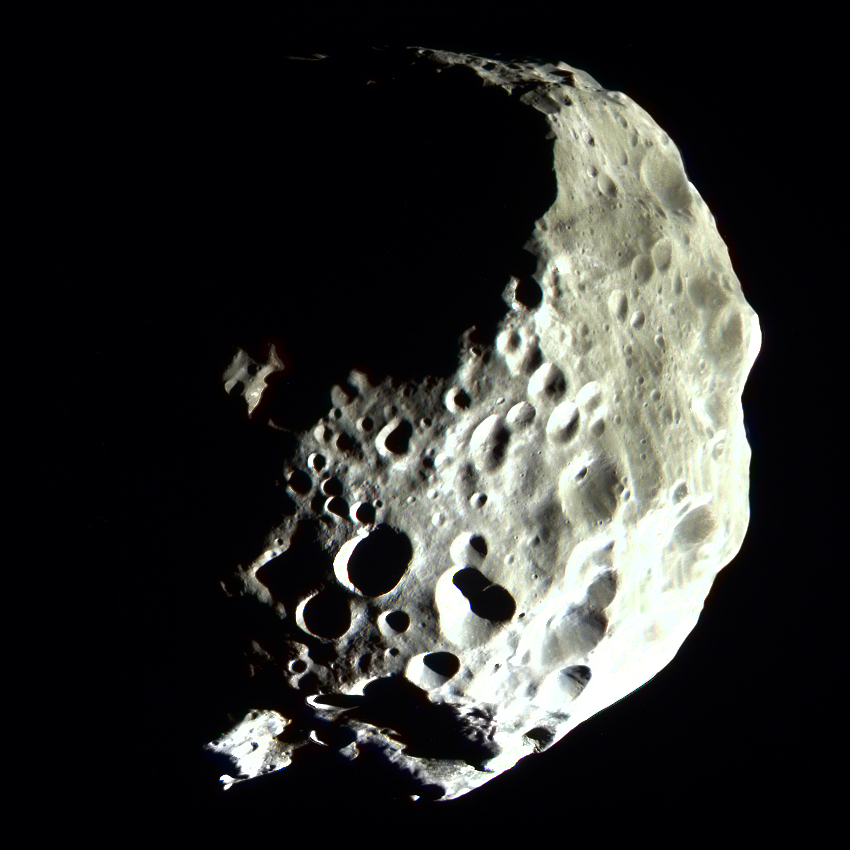
Another beautiful composite by Gordan Ugarkovic, this false-color image shows the ancient cratered surface of Saturn’s moon Phoebe.
About 132 miles across, Phoebe is a fifteenth the size of our own moon but is thought to be much, much older. With its retrograde (backwards) orbit, high orbital incline and extremely dark, pitted surface, it’s believed that Phoebe was once a “Centaur”, a Kuiper Belt object that has been captured by Saturn’s gravity and turned into a permanent member of the family.
Kuiper Belt objects are small rocky bodies that orbit the sun in the far reaches of the solar system. They are primordial remnants from the early days of the solar system, chunks of dark material that never coalesced into larger worlds or changed their chemical structure by solar heating. Centaurs are Kuiper Belt objects that have drifted into the inner solar system.
Phoebe orbits Saturn at a distance of over 8 million miles.
Image credit: NASA/JPL/Gordan Ugarkovic


Cassini’s Phoebe flyby was definitely NOT its finest hour when it comes to the cameras. Almost all the images are overexposed – either the team incorrectly set too long exposures or Phoebe’s brightness was misjudged (not likely, Voyager already got a look at it many years before).
You can clearly see this in the above composite, the lower right part is way saturated.
LikeLike
I’m looking at an amazingly detailed and beautifully composed image of a world billions of years old and millions of miles away. I feel like I could reach out and touch it. I’m not complaining about the exposure settings. 😉
LikeLike
I read the comment first and thought, “What a crank!” until I realized it was Gordan cranking and based on the work he’s done, he can be as particular as he wants. His end-products are true works of image-processing art.
Thanks Gordan.
LikeLike
The real artist is never satisfied with his work.
LikeLike
I don’t think of myself as an artist, but I am a bit of a perfectionist and indeed never really satisfied. To paraphrase someone – I see these images not as how good they are, but great they could have been.
LikeLike
Personally, I like the high contrast lighting. Very dramatic.
LikeLike
David Jewitt’s site http://www.ifa.hawaii.edu/faculty/jewitt/kb.html
has a link to a page called “Is Phoebe a KBO?” (Kuiper Belt Object)
Bottom line is we don’t know where it came from, but he (Jewitt) doubts a couple of recent papers prove it and explains why.
LikeLike
Interesting, if a little over my head with all the g/cm2 talk about density and such. Still, his argument seems to be valid:
“EITHER: Phoebe is an ice/rock planetoid captured from a near-Saturn orbit at the end of Saturn’s growth.
OR: Phoebe is a captured KBO.
We don’t know.” – David Jewitt
Regardless, Phoebe is an anomaly in the Saturnian system if only in terms of its angle and direction of orbit. Plus (and more of interest to me) it makes a wonderful subject for a portrait.
We may not know all the answers for certain but we can at least enjoy the view.
LikeLike
You can learn an enormous amount reading through all his pages. I don’t pretend to understand some of the more arcane stuff, but spending the time is definitely worth it. (Of course, you’re here to show pictures and fuzzy blobs of light moving from here to there – KBO blink sequences – ain’t exactly photogenic).
LikeLike