
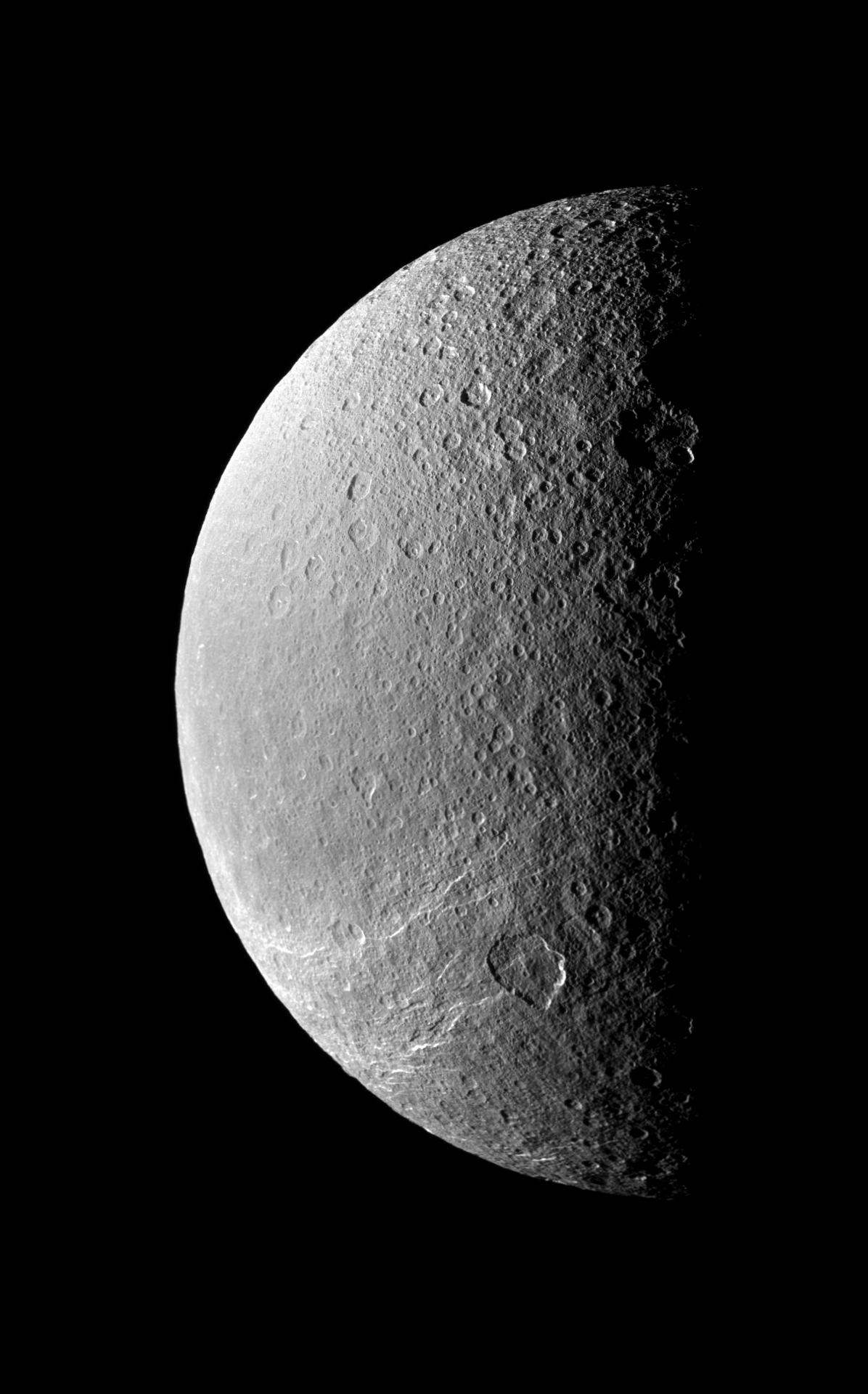
Rhea’s cratered surface appears in high relief in this photo from the Cassini orbiter, taken on February 2, 2009. (Click to view the full version.)
Rhea (REE-ah) is Saturn’s second-largest moon, after Titan, but at 950 miles across compared 3,200, Rhea is dwarfed by her bigger brother. Still, Rhea has some interesting features….it is the only known moon to (speculatively) have its own ring system, a scattered field of rock and dust that may be the remnants of a meteorite impact. And based on its surface it has had plenty of those over the millennia. Its southern region is criscrossed by “wispy lines”…light-colored fractures that extend hundreds of miles and form cliffs hundreds of feet high, slicing through craters and across plains. These may have been caused by ancient tectonic activity, either from tidal forces from Saturn’s pull or heavy bombardment by meteors.
For the most part though, Rhea is another frozen, rocky child of Saturn. Geologically inactive and lacking Titan’s thick hazes, Rhea offers us a clear view of her face, as it is now and has been for millions of years. (Give or take a crater or two.)
Image credit: NASA/JPL/Space Science Institute
 Lights in the Dark