
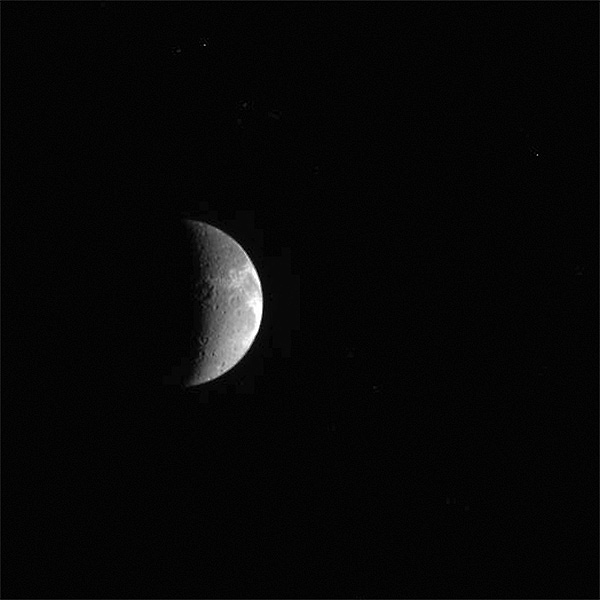
A large-scale crater rides the terminator between day and night on Dione, a 700-mile-wide moon of Saturn. The moon’s signature “wispy lines” can be seen on the sunlit side. These are long fractures in the moon’s surface, exposed ice-covered cliffs hundreds of feet high. Scientists believe they indicate past tectonic activity, or possibly the remnants of geologic vents like Enceladus’ currently active “tiger stripes” features.
Dione was discovered in 1684 by Giovanni Cassini. The spacecraft that bears his name took this photo on May 18, 2009.
Image credit: NASA/JPL/Space Science Institute
 Lights in the Dark