News from MIT on June 17, 2020
A team of astronomers, including researchers at MIT, has picked up on a curious, repeating rhythm of fast radio bursts (FRBs) emanating from an unknown source outside our galaxy, 500 million light years away.This new FRB source, which the team has catalogued as FRB 180916.J0158+65, is the first to produce a periodic, or cyclical pattern of fast radio bursts. The pattern begins with a noisy, four-day window, during which the source emits random bursts of radio waves, followed by a 12-day period of radio silence.
“This FRB we’re reporting now is like clockwork,” says Kiyoshi Masui, assistant professor of physics in MIT’s Kavli Institute for Astrophysics and Space Research. “It’s the most definitive pattern we’ve seen from one of these sources. And it’s a big clue that we can use to start hunting down the physics of what’s causing these bright flashes, which nobody really understands.”
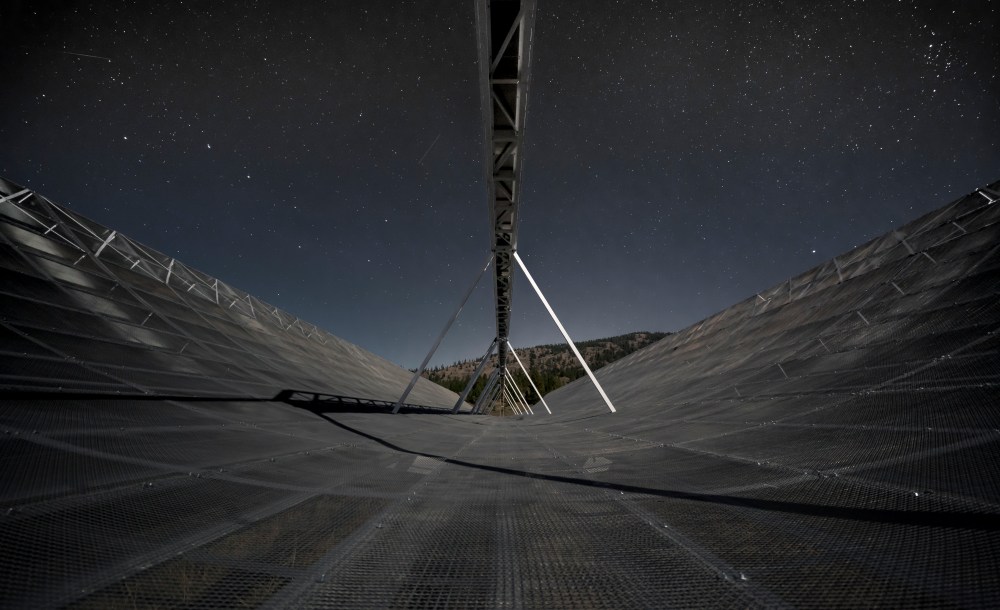
The detections were made with the Canadian Hydrogen Intensity Mapping Experiment (CHIME) radio telescope in British Columbia. Learn more about CHIME here.
As the researchers plotted each of the 38 bursts over time, a pattern began to emerge: One or two bursts would occur over four days, followed by a 12-day period without any bursts, after which the pattern would repeat. This 16-day cycle occurred again and again over the 500 days that they observed the source.
“These periodic bursts are something that we’ve never seen before, and it’s a new phenomenon in astrophysics,” Masui says.
Read the full story by Jennifer Chu at MIT here.
 Lights in the Dark