

I recently had the chance to ask some questions to the people at NASA’s Jet Propulsion Laboratories in Pasadena, CA who are in charge of the Mars rover missions. Behind each of the photos I post here has an entire team of engineers, administrators and talented individuals without whom we would never have seen any of these amazing images from our planetary backyard. For every image, there’s a person who decoded the data. For every boulder-strewn Martian vista we have the unprecedented privilege to see, there’s a person who helped set up the shot.

Bill Nelson is one of those people. Systems Engineer and Mission Manager for the Mars Exploration Rover (MER) program, Bill organizes the team of engineers responsible for the day-to-day activities of the Spirit and Opportunity rovers. He has the privilege of being an integral part of the most groundbreaking exploration of this new century, and I had the privilege of getting his answers to some questions about the missions and the work environment at JPL…
J: What is working at JPL really like?

B: It’s like working for a small team, working for a big company, working at a university and not working at all. Like any big organization, there’s a certain amount of bureaucracy and red tape; but not as much as other places I’ve worked. There is the intimacy of working on the rather small MER team; of vicariously sharing marriages and vacations, birthdays and household problems; of being part of an elite group of smart, dedicated and highly competent people who share a passion for Mars and for the rovers. There are the seminars and talks by everyone from engineers working on various projects to presentations by entrepreneurs, Nobel laureates, senior managers and world-class engineers. There is the freedom from rigid dress codes; even Dr. Elachi, the Laboratory Director, doesn’t always wear a necktie. JPL strives to be diverse, open and non-discriminatory; and on the whole, I think they’ve succeeded. While every job has its ups and downs, I’ve been extremely fortunate to work on projects that excite and inspire me. This isn’t like real work. This is fun!
J: How long do you think the rovers will continue to operate? They’ve already surpassed expectations, but what is their anticipated lifespan the way things are going?
B: While we can’t know how long the rovers will last, we do believe they still have time left because most failures degrade functionality rather than kill the rovers outright. We could lose an actuator at any time, for example, (although we haven’t lost one in over 3 Earth years) but depending on the actuator lost, we could probably find a workaround or mitigation strategy that would let us continue the mission.

The biggest worry is the low energy level on Spirit. Spirit is suffering from too much dust on the solar arrays; and without enough energy, we can’t run the heaters necessary to keep her alive. On the other hand, recent cleaning events on Sols 1812 and 1820-1821 have added about 50 Whr to our daily energy. We are also in that time of the Martian year when winds and dust devils are common. There is, therefore, a good chance of further array cleaning courtesy of Mother Nature. If the worst happens and no further cleaning occurs, the coming Martian winter will be very difficult. At current energy levels and with the constant rain of dust on the arrays, there is only about an even chance for Spirit to make it to spring.
Opportunity has plenty of energy. But she’s doubling her drive distance in her trek from Victoria crater to Endeavour crater. The mobility system is therefore going to be highly stressed and is among the more likely subsystems to have a failure. But a single drive motor failure would, at worst, leave her no worse off than Spirit. Another steering motor failure could probably be overcome by “tank turning” (driving one direction (e.g. forward) on the left side, the other way (e.g. backwards) on the right.
So to answer your question, I’m going way, way out on a limb to predict Spirit will last at least until first quarter, 2010, and Opportunity will last at least another couple of Earth years (another Mars year) and will make it to Endeavour crater. (“Endeavour” is the correct spelling – it’s named for James Cook’s ship.)
J: Are the science and engineering teams at JPL mostly men, women, or are they a general mix of both? What sort of person makes the “ideal” member of the JPL team?
B: I can’t speak for all the various teams at JPL, just the MER team. We have a mix of men and women although more men than women. For example, we have what we call “tactical shifts” where a subset of the MER workforce is assigned to plan and create the sequences to operate one of the rovers for one or more Sols. We try to keep people “on shift” for a week or so at a time (and then off one or more weeks so they can get their other work done). But of course, the result is a constant shuffling of the planning teams. Enough women work on MER that it is rare not to have at least one or two on a planning shift. And last year we had an all-female planning team one day.

While everyone is aware of gender — as they are of race, ethnicity, age, nationality and so forth — it’s a very secondary attribute compared to our focus on function and competence. JPL strives for — and has — a diverse workforce. And as small as it is, the MER workforce reflects that.
J: Will it be possible to send a rover mission to Mars that can then return to Earth with samples?
B: Yes. And in fact, such missions have been proposed for several decades at varying levels of sophistication. Perhaps the biggest hurdle is convincing NASA that it’s worth the cost and mission complexity to return samples compared to analyzing them right there on Mars. For example, the most recent Mars mission, the Phoenix polar lander, carried eight one-time-use mini-laboratories. As electronics, software, micro-machining and other technologies become more sophisticated, a sample return mission could become harder and harder to justify.
J: I am fascinated by space because, honestly, it frightens me. The distances are so vast, the scale so big, it’s incomprehensible. And we have yet to find a place that’s safe for humans. It seems sometimes that we are an island surrounded by an ocean of inhospitality. How do you feel about our “place” in the universe?
B: Space is hostile to humans, no question. But rather than finding it frightening, I approach it with a sense of wonder. Where I can’t personally go, I can send an emissary; in this case two rovers, driving around Mars. They may have their limits (I can’t feel or hear Mars, for example) but I can at least see and move about almost as if I were there. And I’m fascinated by the constantly changing landscape as we drive. I’ve always had a restless urge to see what’s over the next hill. On MER, I have a whole planet to explore.
Space is indeed vast and it can seem incomprehensible. But we’re learning more about the universe every year and that, too, fascinates me because it answers a very human desire to know where we come from and what our story is. And since visualization software can give us a God’s eye view of the universe, it can tame the immensity and thus aid comprehension. Isn’t it interesting, for example, that the stars we see seemingly all at the same distance, are in fact arrayed in walls and filaments, bubbles and voids; and a made that way from initial quantum fluctuations, the expansion of the very fabric of Space and myriads of millennia of gravitational pulls and tugs.
As far as our “place” in the universe, I’d say it’s wherever and whatever we want it to be. We know the technical challenges are great but I believe if we truly want to colonize the Moon or Mars, we can find a way. The implementation at the end may be as different from the concept at the beginning as Leonardo da Vinci’s naive drawings of men with wings are from the airplanes of today. But if we want it, I believe we can achieve it.
___________________________________________
Thanks Bill. Yes, that’s the one defining trait of humankind….if we want it, we will achieve it. It’s only a matter of time.
The photos coming in every day from the rovers are always fascinating to me. Even if just a view of a dune field or a jumble of rocks, it’s a jumble of rocks that no person has ever set eyes on until now. It’s a dune field that has never seen a human footprint, whose dry winds have never been felt on a human face. That’s still the case, of course, but with the rovers there as our eyes, hands and feet, and under the direction of Bill’s team, we’re now a lot closer to the red planet than ever.
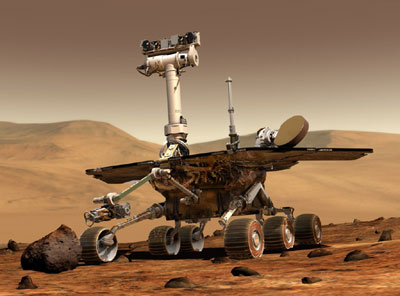 Keep up the great work Bill. My regards to you and the whole MER team. (And also to Guy Webster, who put my questions in front of Bill Nelson in the first place!) All of your talent and vision is truly leading the way for the future of human exploration.
More about the Mars Exploration Rovers.
Image credits: NASA/JPL-Caltech
 Lights in the Dark
Wonderful information!
It must be such an great feeling to be working on a project like this…exploring our solar system!
Thanks for sharing a bit of your world with us!
LikeLike
Great job, Jay!
LikeLike
Thank you for this. It’s always interesting to put a human face on this adventure. Well done!
LikeLike