
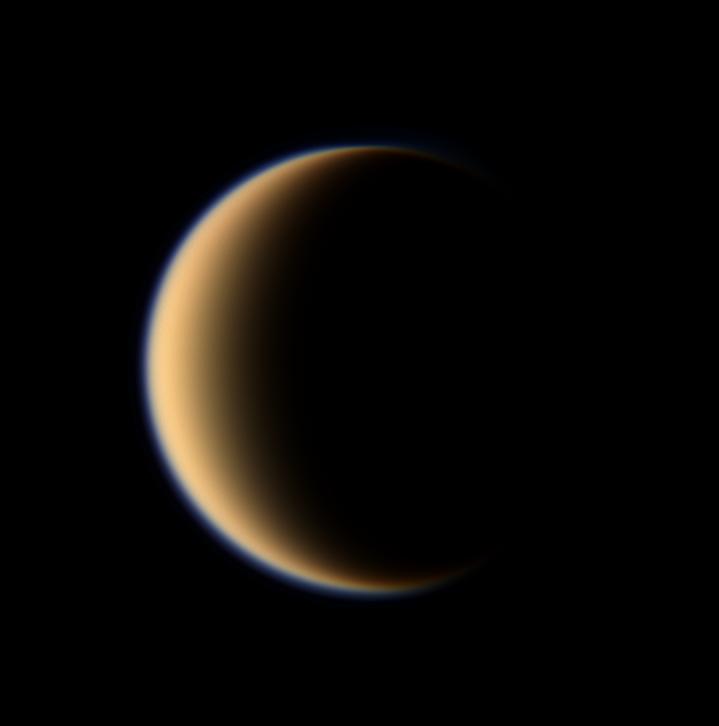
In less than 9 hours the Cassini-Huygens spacecraft will conduct its next flyby of Saturn’s moon Titan, using its radar mapping instruments to pierce the moon’s thick atmosphere and reveal more information about surface features.

In particular, tonight’s flyby will focus on a feature in Titan’s south polar region called “Ontario Lacus”. Originally mapped in 2005, this dark splotch may prove to be a large body of liquid methane approximately the size of Lake Victoria.
3,200-mile-wide Titan resembles a frozen version of a primordial Earth, except with methane and hydrocarbons playing the role of liquid water and liquid water acting as lava. The overcast skies rain down methane, which fills channels and forms streams, rivers and lakes, eroding the landscape as water does on our planet today. With a surface temperature in the low -200 degrees F water remains hard as rock on Titan, except where it may ooze out of thermal vents, heated by internal forces to a “molten” state before it freezes solid.
Titan’s opaque orange haze is nearly impenetrable in ordinary visual light, so Cassini uses radar mapping to discern surface details. We can be sure that whatever it sees in tonight’s flyby will be something new and exciting that we can add to the very short (but growing) list of what’s known about this exciting world!
Image credits: NASA/JPL/Space Science Institute
 Lights in the Dark