

The data is in from today’s flyby of Enceladus and the images so far have not disappointed! The moon’s characteristic southern jets are running at full power, seen above, backlit by the sun and thereby easily visible to Cassini’s cameras. Below are a couple more images, one of Enceladus’ illuminated icy face with Saturn’s ringplane just visible behind, and a more detailed view of the moon’s heavily fractured surface.
Cassini made a low pass over Enceladus, flying 68 miles above the moon and passing through the icy vapors of the plumes in order to gain more data about their composition. It’s possible that the plumes are fed by a subsurface ocean of liquid water, or at least large reservoirs of water, heated by tectonic activity and forced upwards through cracks in the moon’s southern region.
This was the seventh such flyby of Enceladus during the course of the Cassini mission.
Hopefully we’ll be seeing even more images soon! 🙂
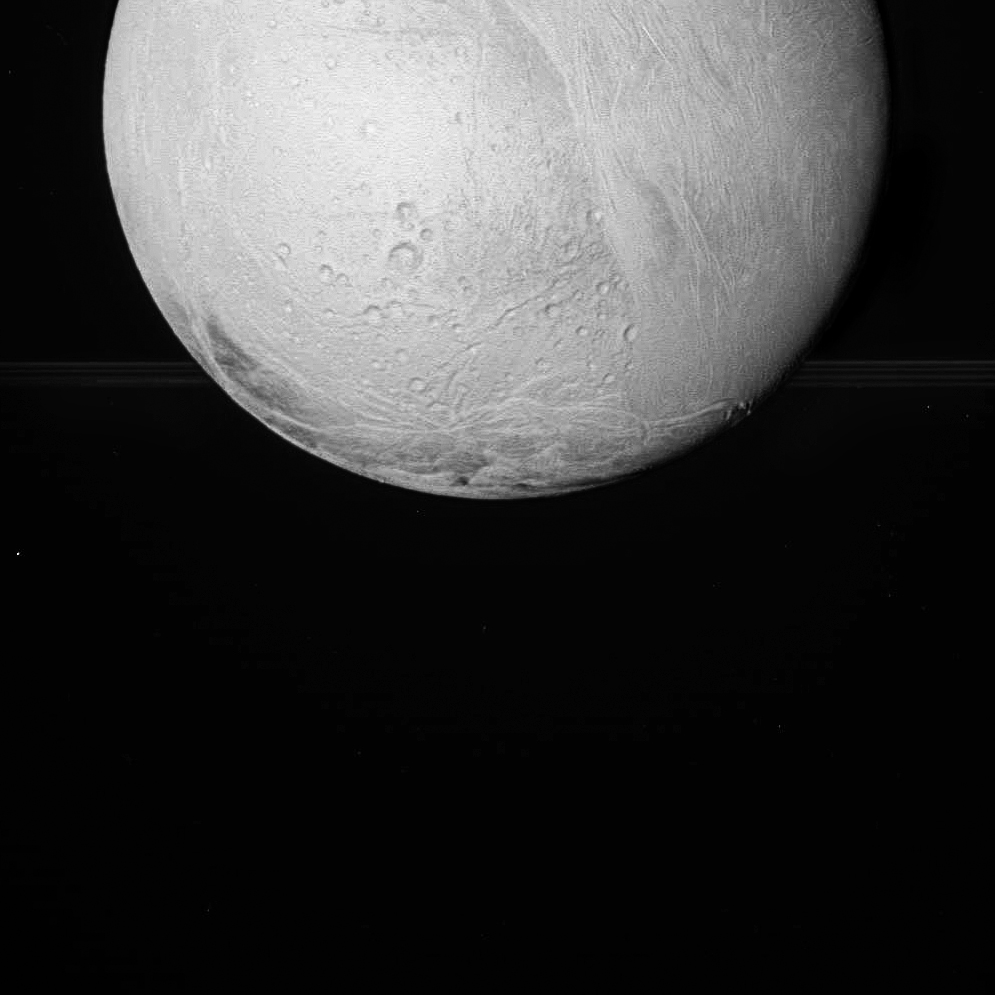
About the size of Arizona – 318 miles across – Enceladus is composed of a lot of water ice and is thus very bright. It reflects almost 100% of the sunlight that it receives. This also makes the moon very cold…its surface temperature is measured at -330ºF! (Not very much like Arizona at all.)

The surface of the moon is very textured in places, smooth in others. The region where the plumes originate is marked by deep troughs, known as “tiger stripes”. Geologically young, the surface of Enceladus is believed to be less than 100 million years old.

“Of all the geologic provinces in the Saturn system that Cassini has explored, none has been more thrilling or carries greater implications than the region at the southernmost portion of Enceladus.”
– Carolyn Porco, Cassini Imaging Team Leader, December 2008.
See more images from the flyby on the Cassini Imaging site here.
Image credits: NASA/JPL/Space Science Institute
 Lights in the Dark